TunisianPass
My first business started with a restaurant around the corner.
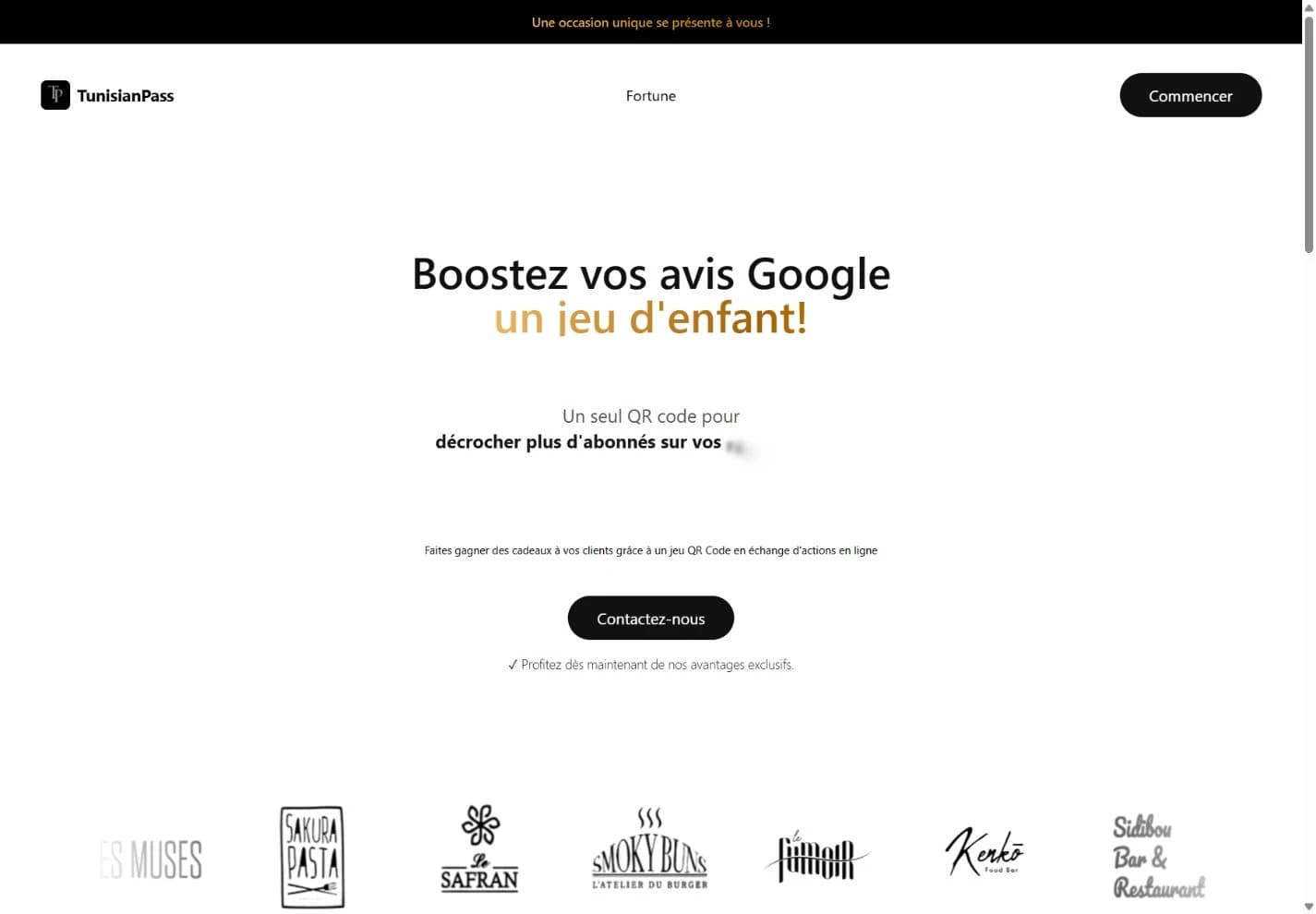
- to build our first prototype
- 2 weeks
- business customers
- 20+
- monthly users
- 500+
In summer 2024, my co-founder and I had energy, some web development experience, and a growing list of restaurant owners we knew. We had been selling small websites to local businesses. That gave us a starting point: we could build something, and we knew people willing to try it.
TunisianPass grew out of those conversations. It became my first company in Tunisia and the project that taught me what happens after someone agrees to pay for your work.
An idea brought back from France
During a trip to France, my co-founder noticed QR codes in restaurants that connected customer reviews with small rewards. He came back convinced we could build a product around that idea. I was immediately on board.
Our vision was a simple customer engagement service for local businesses. A QR code on the table could open an interaction with a customer, encourage feedback, and help a business stay in touch. We already knew the restaurant environment from selling websites, so we could test the idea with people we knew.
Two weeks of building, one month of testing
We built a prototype in two weeks and called an existing client, a restaurant in our neighbourhood. We offered a free month so the owner could see whether the product was useful before committing.
At the end of that month, the owner told us the restaurant had received 300 reviews. He was happy enough to buy a year. That first subscription gave us money to work with and a reason to keep going. It also gave us a customer who helped us improve the product while it was still rough.
The product also had to work on a table
The website was only part of what we delivered. We started working with printers, trying different sticker materials and improving the print quality. Our first restaurant let us test several versions in a real setting.
We added tabletop stands and offered the printed materials alongside the service. I had to think about an object someone would actually pick up or scan in a restaurant. Production, print quality, and delivery became part of our work.
Learning to walk in and explain it
We spent days visiting businesses. We mapped areas around us and kept track of where we had met the owner, presented the product, or needed to come back. Each conversation helped us change our pitch and understand what mattered to the person across the table.
Meanwhile, existing customers were sending feedback. We fixed bugs and changed the product as we learned how people used it. Sales and development happened together. A conversation in a restaurant could turn into something to fix that evening.
Beyond our first neighbourhood
We reached more than 20 business customers, including restaurants, shops, hotels, a concept store, and an amusement park. The service also passed 500 monthly users. Signing a customer in Indonesia made the project feel bigger than the places we could visit ourselves.
We created a company after our first revenue and explored how to grow it. We spoke with a startup accelerator, but the involvement it required was difficult to reconcile with our studies. We decided to keep our education as a priority.
An honest ending to the company
University changed what we could manage. I was heading to Switzerland and my co-founder to Paris. We tried bringing in students we knew in Tunisia to help sell the product, but we struggled to build a team that could keep the business moving without us being there.
We eventually closed the legal company and stopped actively developing the product. Existing installations are still in use and we remain in contact with customers. I want to be clear about that distinction when I talk about this project.
Looking back
What I took with me
I remember walking into the first restaurant as clearly as the first subscription. TunisianPass taught me to listen to someone using what I had built, accept that the first version needed work, and make decisions with limited time and money.
I am proud of what we built together, including the less comfortable decisions. When my co-founder and I later started WeLockIn, we brought that experience with us: speak to people early, test in their real lives, and take their feedback seriously.